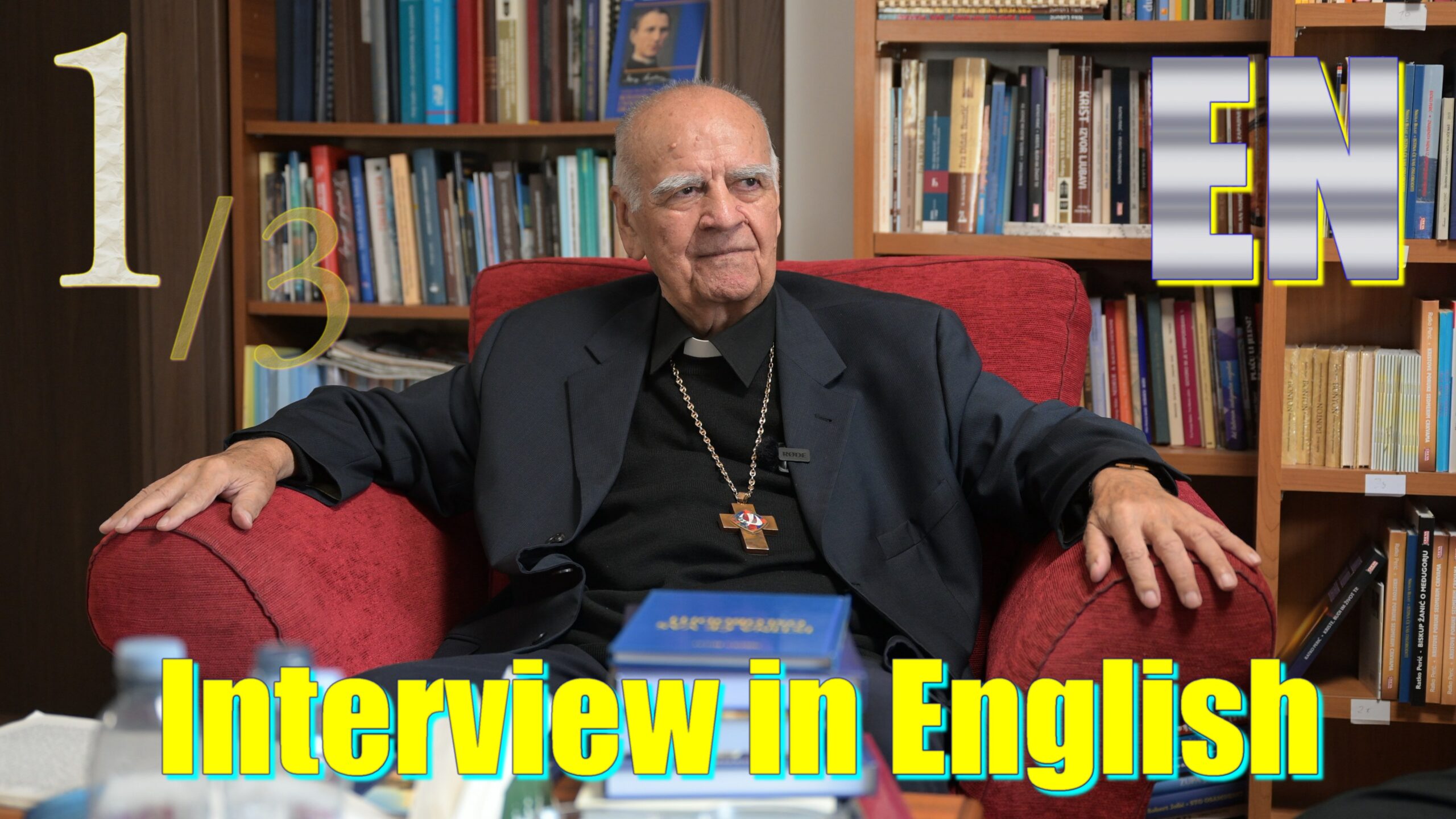
Preface to the Interview
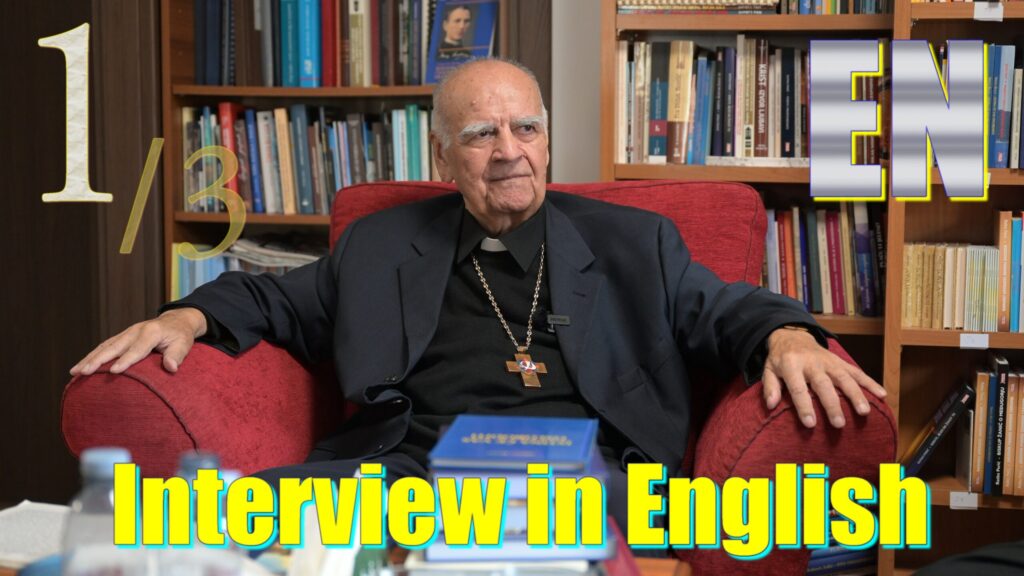
Mission Fatima is the first and, so far, the only organisation in Slovakia to present an authentic interview with Bishop Ratko Perić, Bishop Emeritus, who headed the Diocese of Mostar-Duvno from 1993 to 2020. The Marian pilgrimage site of Medjugorje is also located within the territory of this diocese. It continues to generate growing controversy and raise numerous unanswered questions.
We are publishing the interview gradually in three parts, in the original language in which our editor, Anton Kulan, communicated with Bishop Perić – Croatian. At the same time, we have had it translated not only into Slovak, so that it would be accessible to our local readers, but also into several world languages.
Our aim is to ensure that credible, verified and reliable information directly from the primary source – Bishop Perić – reaches the widest possible audience around the world, not just in Slovakia.
In this way, we want to help clarify the facts, refute the rumours circulating about Bishops Žanić and Perić, and above all, counter disinformation about the Medjugorje phenomenon and the alleged apparitions which, according to the claims of the visionaries, have been taking place there for more than 45 years.
We decided to divide the interview into three parts because it is rich in content and contains a great deal of important information about the phenomenon of Medjugorje that has not previously been published anywhere. We want to give you the opportunity to absorb this information gradually, take time to reflect on it and, if you wish, verify it online using the available sources.
Finally, we would like to share a request and a prayer that were also featured in our video about the journey to Mostar:
May the Holy Spirit open your hearts to receive the truth, so that you may not be misled by the temptations of the Evil One – the angel of division, the Devil. May your hearts be open to the truth that Bishop Perić and we at Mission Fatima wish to share with you.
The interview questions were prepared by Anna Kulanová and Anton Kulan. Anton Kulan conducted the interview in writing. It consists of 15 questions, and in this first instalment, we present the first five.
1) How did the rumour begin that Bishop Žanić collaborated with the Communists to discredit the alleged apparitions?
These rumours arose against the backdrop of the conflict between the Communist authorities and the Church, as well as later disputes over the interpretation of the events in Medjugorje. The claim that Bishop Žanić became an associate of the UDBA (Yugoslav communist secret police) due to blackmail first appeared in 1985, according to Church documentation. It was later revived in the 1995 film Gospa: The Miracle of Medjugorje, directed by the Croatian filmmaker Jakov Sedlar. The Diocesan Ordinariate of Mostar responded by stating that the film was false and malicious, as it portrayed Bishop Žanić (referred to as „Bishop Šubić“) as an UDBA collaborator.
The claim resurfaced in 2017 film From Fatima to Medjugorje, which drew a sharp response from the then-Vicar General, Father Željko Majić – now the Bishop of Banja Luka.
A fuller account is provided in the 2021 monograph Biskup Žanić o Međugorju. Istinom po neistinama („Bishop Žanić on Medjugorje: Addressing Untruths with the Truth“). This work includes 33 documents from Bishop Žanić’s tenure (1981–1993). In its appendix – titled „Was Bishop Žanić an ‚UDBA agent‘?“ (pp. 187–207) – it is documented that he was not!
2) What problematic elements did Bishop Žanić identify within the messages?
Bishop Žanić exposed falsehoods in the accounts given by certain visionaries who spoke with him in Mostar, as well as the lies in statements made by Friar Tomislav Vlašić – including his false oath that he did not possess Vicka’s Diary – even though a comparison of the texts from the Diary and the Chronicle reveals that the latter was copied from the former.
He also exposed the lies of the visionaries who claimed that Gospa had forbidden them from writing about the „sign“; yet, she did not forbid Ivan Dragićević from doing so – he even wrote, in the presence of the Commission members, that a sign would occur – but nothing happened (a facsimile appears in Ogledalo Pravde /“Mirror of Justice“/, Mostar, 2001, p. 104).
SUPPORT OUR WORK AND MISSION!
The journey to Mostar was very demanding to organize, costly, and required thorough preparation. Despite all the obstacles, we undertook it with one goal in mind: to bring you important information, seek the truth, and share testimonies and insights that you might otherwise never have had access to.
We would like to continue this work and bring you more interviews, reports, and other materials of this kind. To do so, however, we also need your help. We kindly ask you to support our work so that we can continue the mission we believe is important.
If you are able to do so, please consider making a donation of any amount through our donation website: https://MILODAR.MisiaFatima.sk. There, you can also receive a book in recognition of your support for Mission Fatima. Give the book to your loved ones and friends as a Christmas gift…
3) Your Excellency, what convinced you that the apparitions were not of a supernatural nature? Could you describe how difficult the task was for Bishop Žanić and yourself, and why people refused to listen when you stated that the apparitions were not authentic?
First, the more I studied the matter, the more I encountered documents proving that the Medjugorje phenomenon is a pattern of various manipulations and falsehoods. It starts with the initial claim on 24 June 1981, when some of the „visionaries“ said they had gone out to „look for sheep“ (when in fact they had gone out to „smoke“), and continuing to the well-known incident on the 30th June, when „Gospa“ told them that she would appear for „three more days“ – only to change her mind and, well, continue appearing for 45 years!
Second, it is in human nature to gravitate toward the path of least resistance; as St. Paul warned: „And will indeed turn away their hearing from the truth, but will be turned unto fables“ (2 Timothy 4:4).
TEAMWORK OF THE ENTIRE EDITORIAL TEAM
The entire Mission Fatima editorial team took part in preparing the full interview, translating the text you are reading, and producing all its subsequent language versions. We paid particular attention to thoroughly verifying the facts and information presented in the interview. We fully stand by their truthfulness and accuracy.
The final text is the result of the dedicated work of several people, not just the Kulan couple, who personally met with Bishop Perić in Mostar on Friday, 30 October 2026, and also conducted a video interview with him. This is also why preparing and editing the individual language versions took us an entire month.
Thank you for your patience and interest!
We also kindly ask you to support our mission through your prayers and a financial donation according to your means, paid into our bank account: SK77 8330 0000 0048 5555 7777.
4) I dislike reminding you of such a painful experience – and believe me, I am truly sorry to have to do so – but in his research, Mr. Foley mentions that you were abducted by fanatics of the apparitions and that UN forces had to secure your release. What happened back then? Why did they abduct you? What was their objective, how long did they hold you, and is it true that they beat you and tore the cross from your chest? Were these individuals believers in the Medjugorje apparitions?
That valuable experience, and the humiliation of myself and the diocesan chancellor, Father Ante Luburić, took place on Sunday, 2 April 1995, between 2:00 and 10:00 p.m. We provided a detailed account in a special supplement to the monthly Crkva na kamenu (Church on the Rock), no. 4/1995; the supplement spans eight pages.
Why did they abduct us? It was more on account of the „Herzegovina case“ than the „Medjugorje phenomenon.“ It was not UN forces that secured our release, but rather, primarily, the mayor of Mostar, Mijo Brajković (1946–2019). It is said that there was a flurry of phone calls between Zagreb, Rome and Mostar.
In Mostar, until 1980 there was only one parish, entrusted to the Franciscan fathers. The cathedral was consecrated in 1980, and a parish was established alongside it at that time, but only a certain number of Franciscans recognized it. On Epiphany 1993, Bishop Žanić established four parishes in Mostar – carved out exclusively from the territory of the cathedral parish – each dedicated to one of the four Evangelists. Four diocesan priests were appointed there. Many Franciscans in particular, refused to recognise these new parishes. It was only from this point on that the „Herzegovina case“ began to be addressed in earnest. In principle, it was resolved in 2000, followed by a joint statement from the Minister General of the Order and the Bishop of Mostar in 2003. Nine friars rebelled and were consequently dismissed from the Order – though they remain unconcerned by this fact. Four have since passed away. One of them, before his death in early 2022, handed „his“ parish over to the bishop. However, five others continue to hold four parishes that the Holy See had assigned to the diocesan clergy via the 1975 decree Romanis Pontificibus. Furthermore, one of these individuals in Mostar intrudes into three canonically established parishes. These former friars also keep a certain number of parishioners under their own „rule“ and „authority“.
WE ASK FOR YOUR PRAYERFUL SUPPORT!
It is not easy for us. Every day, we face attacks from our detractors and fanatical devotees of “the Gospa.” These attacks come in the form of hateful comments, emails, and phone calls. Sadly, we have also already experienced our first face-to-face confrontations with people associated with the Slovak Covenant. You will surely also remember the accusations hurled at Mr. Zbiňovský during the live broadcast…
That is why we are turning to you with an urgent request: Pray for those who attack us, that the Lord may free them from blindness, hatred, and fanaticism. But pray for us, too, that we may not lose courage, give in to fear, or waver in our struggle for the truth – even when it becomes difficult!
We ask you to offer at least one prayer of the Hail Mary – Ave Maria in Latin – for us each day. This may seem like a small thing, but we believe that the power of prayer can accomplish more than human anger and slander.
We thank you from the bottom of our hearts for every prayer, for your courage in standing by the truth, and for your support!
5) Which messages from Medjugorje are – to put it mildly – controversial?
The disputed messages are listed in the book Ogledalo Pravde (pp. 75–138). Of the roughly 80 messages reproduced in that book from the Medjugorje parish Chronicle, not a single one – with that specific content and those specific dates – appears in the collections of messages from the Medjugorje Marian apparitions, not even in the Raccolta completa dei messaggi della Regina della pace (Shalom, 2024).
SUPPORT MISSION FATIMA AND BECOME PART OF OUR MISSION!
If you care about spreading the truth, defending fidelity to the teachings of the Catholic Church, and having the courage to call things by their proper names, we ask you to support our work in a practical way as well.
Producing interviews, articles, videos, translations, and other materials requires time, effort, and financial resources. Every donation you make, regardless of the amount, helps us continue our work, provide verified information, and make it accessible to more people.
If you are able to do so, please consider making a donation of any amount through our donation website: https://MILODAR.MisiaFatima.sk
Alternatively, you can send your DONATION directly to our bank account:
IBAN: SK77 8330 0000 0048 5555 7777
DONATIONS from the Czech Republic: 48 5555 7777 / 2010
We sincerely appreciate every contribution. Thanks to your generosity, we can continue a mission that goes beyond what any one individual could accomplish alone.
Don’t remain merely readers and viewers – become part of Mission Fatima!
THANK YOU FOR YOUR SUPPORT!
Questions from Part 2:
6) How was it possible for this phenomenon to spread so widely despite the negative positions of Church authorities, such as the Zadar Declaration of the Bishops’ Conference? Did people defy the ban on pilgrimages?
7) People ask us which priests were disobedient to their local bishops and in what way.
8) As for Father Tomislav Vlašić, promoters of the apparitions claim that what happened back then is now long past and that he played virtually no role at all. However, the parish Chronicle states that he was the spiritual director of the visionaries and that, according to the Gospa, the visionaries should be grateful to him for his good spiritual guidance. We also know that Marija retracted her testimony in which she had claimed that the Gospa had approved Vlašić’s community, and admitted that Vlašić had pressured her into making that original statement about the Gospa’s approval. So what role did Vlašić actually play, and how long did he remain in Medjugorje?
9) Were the young visionaries manipulated by the Franciscans? Why did the Franciscans refuse to hand over the administration of the parish to the local bishop?
10) The exorcist Andrea Gemma criticized the visionaries for their way of life. What did he mean by that, given that you know them personally?
Questions from Part 3:
11) Is it true that, of all the apparitions examined, the Ruini Commission was able to support only the first seven – and even then only because it lacked key written statements from the local bishops and documents from the Dicastery, as David Murgia later revealed by publishing the minutes?
12) In 2016, a vote on the apparitions in Medjugorje was held at the Dicastery for the Doctrine of the Faith among 33 theologians and cardinals. An overwhelming majority reached the same conclusion as the Zadar Declaration – the statement issued by the entire Bishops’ Conference – namely, that the supernatural origin of the apparitions could not be confirmed. However, in 2016, six theologians, including three cardinals, spoke of direct demonic influence or “satanophany” and agreed that these apparitions could not be explained without demonic influence. Could you tell us more about this?
13) How can we explain the fact that these young visionaries resisted the pressure of the communist regime and persisted in their claims about the apparitions?
14) In the 2024 document The Queen of Peace: A Note on the Spiritual Experience Connected with Medjugorje, Cardinal Fernández speaks of good fruits. Father Amorth, unlike the exorcist Bishop Gemma, also praised the good fruits of conversion and the large number of confessions in Medjugorje. How do you understand this message about good fruits? Are the bad fruits being concealed or kept out of the public eye?
15) Are there any verified miracles or healings associated with Medjugorje?
[CS] Tento rozhovor jsme přeložili také do češtiny. (Czech – Czech Republic)
[DE] Dieses Interview haben wir auch ins Deutsche übersetzt. (German – Germany, Austria)
[EN] We have also translated this interview into English. (English – United States, United Kingdom)
[ES] También hemos traducido esta entrevista al español. (Spanish – Spain, Mexico)
[FR] Nous avons également traduit cet entretien en français. (French – France)
[HR] Ovaj razgovor donosimo i u izvornom obliku na hrvatskom jeziku. (Croatian – Croatia)
[HU] Ezt az interjút magyar nyelvre is lefordítottuk. (Hungarian / Hungary)
[IT] Abbiamo tradotto questa intervista anche in italiano. (Italian – Italy)
[NO] Vi har også oversatt dette intervjuet til norsk. (Norwegian – Norway)
[PL] Ten wywiad przetłumaczyliśmy również na język polski. (Polish – Poland)
[PT] Esta entrevista também foi traduzida para português. (Portuguese – Portugal)
[RO] Acest interviu a fost tradus și în limba română. (Romanian – Romania)
[RU] Мы также перевели это интервью на русский язык. (Russian – Russia)
[RUE-LAT] My tiž perevely tot rozhovor na rusynsky jazyk (rusynsky jazyk)
[RUE-AZB] Мы тіж перевели тот розговор на русиньскый язык. (русиньскый язык)
[SE] Vi har även översatt denna intervju till svenska. (Swedish – Sweden)
[SK] Tento rozhovor sme preložili aj do slovenčiny. (Slovak – Slovakia)
[SL] Ta intervju smo prevedli tudi v slovenščino. (Slovenian – Slovenia)
[UA] Це інтерв’ю ми також переклали українською мовою. (Ukrainian – Ukraine)